Your financial advisor doesn’t operate in a vacuum. They work under the supervision of a brokerage firm that is responsible for their conduct and compliance with industry rules. Understanding the firm is just as critical as understanding the individual advisor. This review focuses on both Centaurus Financial, Inc. Broker Curtis Edmark and the firm he is affiliated with. We will explore the business model of Centaurus Financial, its regulatory history, and the investor protections it offers. This information provides crucial context, helping you understand the full scope of the relationship and who is ultimately accountable for the advice you receive and the performance of your investments.
Key Takeaways
- Verify an Advisor’s History Yourself: Before investing, use free tools like FINRA’s BrokerCheck to independently review a professional’s licenses, employment background, and any past disciplinary actions or customer disputes.
- Look Beyond the Advisor to the Firm: The brokerage firm is responsible for supervising its advisors. It’s important to know that investor protections like SIPC cover firm failure, not financial losses from unsuitable advice.
- Identify Red Flags and Know Your Rights: Be cautious of guaranteed returns, high-pressure tactics, or a lack of transparency. If you suspect misconduct, you have legal options to hold both the advisor and their firm accountable for your losses.
Who is Curtis Edmark?
If you’re considering working with Curtis Edmark or have already invested with him, it’s helpful to have a clear picture of his professional history. He is a financial advisor currently associated with Centaurus Financial, Inc., and has a career spanning several decades. Understanding an advisor’s background and the firms they have worked for is a critical first step in protecting your financial interests and making informed decisions about your investments. This information provides context for their experience and the type of services they offer.
A Look at His Professional Background
Curtis Edmark has been in the financial services industry for over 28 years. His public records show he is affiliated with Centaurus Financial, Inc., and was previously with Pioneer Financial Group. He holds Series 63 and Series 66 licenses, which are required for advisors to conduct business in certain capacities. These licenses qualify him to act as both a broker-dealer agent and an investment adviser representative. It’s crucial for investors to verify an advisor’s credentials and be aware of any history of broker fraud and negligence tied to their record or their affiliated firms.
His Role at Pioneer Financial Group
While at Pioneer Financial Group, Edmark’s focus was on helping retirees manage their finances. His stated goal was to assist clients in increasing their cash flow and net worth during their retirement years. This specialization means he often works with individuals who have accumulated significant savings and are relying on that capital for their future. When an advisor works with retirees, it’s especially important that their recommendations are suitable and align with the client’s long-term needs and risk tolerance. Any mismatch can lead to serious investment issues and potential losses for those who can least afford it.
What is Centaurus Financial, Inc.?
When you work with a financial advisor, you’re often not just working with that individual but also with the firm they represent. Understanding the firm is a key part of protecting your investments. Centaurus Financial, Inc. is an independent broker-dealer, which means it provides a platform for financial advisors to offer securities, investment advice, and insurance products to clients across the country.
Think of a broker-dealer as the operational backbone for your advisor. They handle the trading, compliance, and administrative tasks that allow advisors to manage client accounts. Because Centaurus is an independent firm, the advisors who affiliate with it can operate their own practices while using the resources and product offerings provided by Centaurus. This structure is common in the financial industry, but it’s important for you, the investor, to know who is ultimately responsible for supervising your advisor’s activities and ensuring they follow industry rules. If issues arise, both the advisor and the firm could be held accountable for any broker fraud and negligence.
Understanding Its Business Model
Centaurus Financial describes itself as a firm that offers a full range of financial products and services. This includes buying and selling investments like stocks and bonds (securities), providing ongoing financial advice, and offering various insurance products. Their goal is to equip their affiliated advisors with the tools needed to help clients pursue their financial objectives, whether that’s planning for retirement, saving for college, or growing wealth. Because they are licensed nationwide, their network of advisors serves a broad client base with diverse financial needs. This model allows them to offer a wide variety of investment options, but it also places a significant responsibility on the firm to properly vet these products and supervise their advisors’ recommendations.
The Firm’s Regulatory History
To operate legally, Centaurus Financial must be a member of the Financial Industry Regulatory Authority (FINRA) and the Securities Investor Protection Corporation (SIPC). These memberships require the firm to adhere to a strict set of rules designed to protect investors from misconduct. They are also regulated by the U.S. Securities and Exchange Commission (SEC). This oversight is meant to ensure that the firm and its advisors act in your best interest. However, it’s important to remember that regulatory history is not a guarantee of future performance or conduct. When disputes happen, investors often turn to a process called securities arbitration to resolve them, which is a formal way to handle claims against a firm or its representatives.
What Services Does Curtis Edmark Offer?
When you’re considering working with a financial advisor, it’s important to understand exactly what they do. Public records show that Curtis Edmark provides a range of services that fall into a few main categories, from general financial planning to more specific products like insurance. Knowing the scope of an advisor’s offerings can help you determine if they are the right fit for your financial goals and whether their advice aligns with your best interests.
Financial Planning and Investment Services
Curtis Edmark is registered to offer a broad suite of financial planning and investment services in Arizona, Florida, and Wisconsin. Having passed the Series 63 and Series 66 exams, he is licensed to provide services that include creating financial plans, managing portfolios for individuals and small businesses, and offering pension consulting. His firm’s services also extend to selecting other advisers and publishing newsletters. Understanding these offerings is the first step in evaluating any potential investment issues that could arise from an advisor’s recommendations or management style.
Focus on Retirement Planning
With a career spanning more than two decades in the financial and insurance industries, Curtis Edmark’s primary professional focus is on retirement planning. His stated goal is to assist retirees with increasing their cash flow and net worth to help them achieve a secure retirement. Many investors seek out advisors with this specialty, hoping to protect the assets they’ve worked hard to accumulate. Unfortunately, this is also a time when investors can be most vulnerable to broker fraud and negligence, making careful vetting of any retirement-focused advisor absolutely essential.
Insurance and Risk Management Products
In addition to investment management, Curtis Edmark’s services also extend into the world of insurance. He offers various insurance and risk management products that are typically designed to help clients protect their assets and prepare for unexpected life events. These products are often presented as a way to create a comprehensive financial safety net that works alongside an investment strategy. If you feel that insurance products were misrepresented or sold to you under unsuitable terms, it may be time to contact a legal professional to review your situation.
Checking Curtis Edmark’s Qualifications
Before you trust anyone with your financial future, it’s crucial to verify their credentials. This isn’t just about building trust; it’s a fundamental step in protecting your investments. Looking into an advisor’s licenses and registrations gives you a clear picture of their qualifications and the jurisdictions where they are legally allowed to provide advice. This process helps you confirm that the person you’re considering is in good standing with regulators and has met the baseline requirements for the industry.
Think of it as doing your homework. Every investor should take the time to look up this information, which is publicly available. It’s a straightforward way to start your due diligence and ensure you’re working with a professional who is authorized to handle your money. Taking this step can help you avoid potential investment issues down the road. Verifying these details upfront provides a layer of security and peace of mind. It confirms that the advisor has subjected themselves to the scrutiny of regulatory bodies and has passed the necessary examinations to prove their knowledge. This isn’t a step to be skipped, no matter how trustworthy an advisor may seem. The financial industry has specific rules and regulations for a reason—to protect you, the investor. Making sure your advisor is compliant is your first line of defense.
His Industry Licenses (Series 63 & 66)
Public records indicate that Curtis Edmark holds Series 63 and Series 66 licenses. The Series 63, known as the Uniform Securities Agent State Law Examination, covers the principles of state securities regulations. Passing this exam demonstrates that an individual understands the ethical practices and fiduciary obligations required under state laws.
The Series 66, or the Uniform Combined State Law Examination, combines the requirements of the Series 63 and Series 65 exams. It qualifies a professional to register as both a securities agent and an investment adviser representative. You can always verify an advisor’s current licenses and exam history using FINRA’s BrokerCheck tool, a free resource for investors.
States Where He Is Licensed to Practice
An advisor must be licensed in your state of residence to legally offer you investment advice or sell you securities. According to his public registration details, Curtis Edmark is licensed to practice in several states, including Arizona, Florida, and Wisconsin. This multi-state registration allows him to work with clients who reside in those specific areas.
It’s always a good idea to confirm that your advisor is registered in your state before you begin working with them. Operating without the proper state license can be a significant red flag and may be a form of broker fraud and negligence. Verifying this information is a simple yet essential part of protecting your financial interests.
A Look at His Community Involvement
When you’re researching a financial advisor, you’ll often find information about their community work and charitable activities. This is a common way for professionals to build a positive public image and establish trust. While these efforts can be admirable, they are just one piece of the puzzle. It’s important to look at the complete picture, including their professional history and regulatory record, to protect yourself from potential broker fraud and negligence. Curtis Edmark’s public profile includes details about his involvement in educational programs and local initiatives.
Scholarship and Grant Programs
According to his personal website, Curtis Edmark has established two financial aid programs: the Curtis Edmark Scholarship and the Curtis Edmark Grant. These initiatives are presented as a way to offer financial support to college students across the United States. The stated goal is to help students manage the costs of higher education. This focus on education is highlighted as a key part of his commitment to supporting the next generation of professionals and is a significant feature of his public-facing persona.
Local Community Initiatives
In addition to the educational programs, Edmark’s public profile emphasizes a strong commitment to local community involvement. His website mentions collaborations with various local organizations aimed at creating positive change. This work is framed as a core part of his identity, showcasing a dedication to fostering a supportive and thriving environment for residents in his community. Like the scholarships, these activities are a prominent part of the professional image he presents to the public and potential clients.
Understanding Centaurus Financial’s Investor Protections
When you work with a brokerage firm like Centaurus Financial, you’ll often hear about various safeguards designed to protect your money. While these protections are an important part of the financial industry’s structure, it’s vital to understand what they actually cover and, more importantly, what they don’t. Firms are required to be members of regulatory bodies and carry certain insurance, but these measures have specific limits. Knowing these details can help you better assess the risks associated with your investments and understand your options if something goes wrong.
What SIPC and Other Insurance Really Covers
Centaurus Financial is a member of the Securities Investor Protection Corporation (SIPC), a fact often highlighted to give investors peace of mind. However, it’s crucial to understand that SIPC is not the equivalent of FDIC insurance for your bank account. SIPC’s primary role is to help you recover your securities and cash if your brokerage firm fails financially. It does not protect you from making a bad investment or from losses caused by negligent advice. If your portfolio’s value drops because of unsuitable recommendations or other forms of broker fraud and negligence, SIPC coverage will not help you recover those losses.
The Role of Custodians like Pershing and Schwab
To add a layer of security, Centaurus uses large, independent custodians like Pershing and Charles Schwab to hold client assets. This means your money and securities aren’t held directly by Centaurus but by a separate, major financial institution. This practice can protect your assets if Centaurus itself faces financial failure. However, the custodian’s role is primarily administrative. They execute trades and hold the assets, but they do not supervise your broker or approve their investment recommendations. The responsibility for providing suitable financial advice still rests entirely with the advisor and their firm, which is where many investment issues originate.
FINRA and SEC Oversight Explained
Centaurus Financial, like all registered brokerage firms, is regulated by the Financial Industry Regulatory Authority (FINRA) and the U.S. Securities and Exchange Commission (SEC). These organizations create and enforce the rules that govern the securities industry to ensure fair practices. While this oversight is essential, it doesn’t prevent every instance of misconduct. Regulators can discipline firms and individuals for breaking the rules, but their actions may not directly result in you getting your money back. When a broker’s actions cause you financial harm, the path to recovering losses is often through a formal dispute process like securities arbitration.
Your Checklist Before Choosing Any Financial Advisor
Handing over your life savings to someone is a massive decision, and it’s one you should never take lightly. Doing your homework before you commit can save you from financial hardship and immense stress down the road. Trust is earned, and in the financial world, it must be verified. A thorough vetting process is your first line of defense in protecting your assets and ensuring your financial future is in capable hands.
Think of this as a job interview where you are the hiring manager. You need to be confident that the person you choose has the right qualifications, a clean record, and your best interests at heart. This checklist will walk you through the essential steps for evaluating a financial advisor and show you how to identify warning signs before it’s too late. Taking these steps can help you avoid common investment issues and find a professional you can truly partner with for the long term.
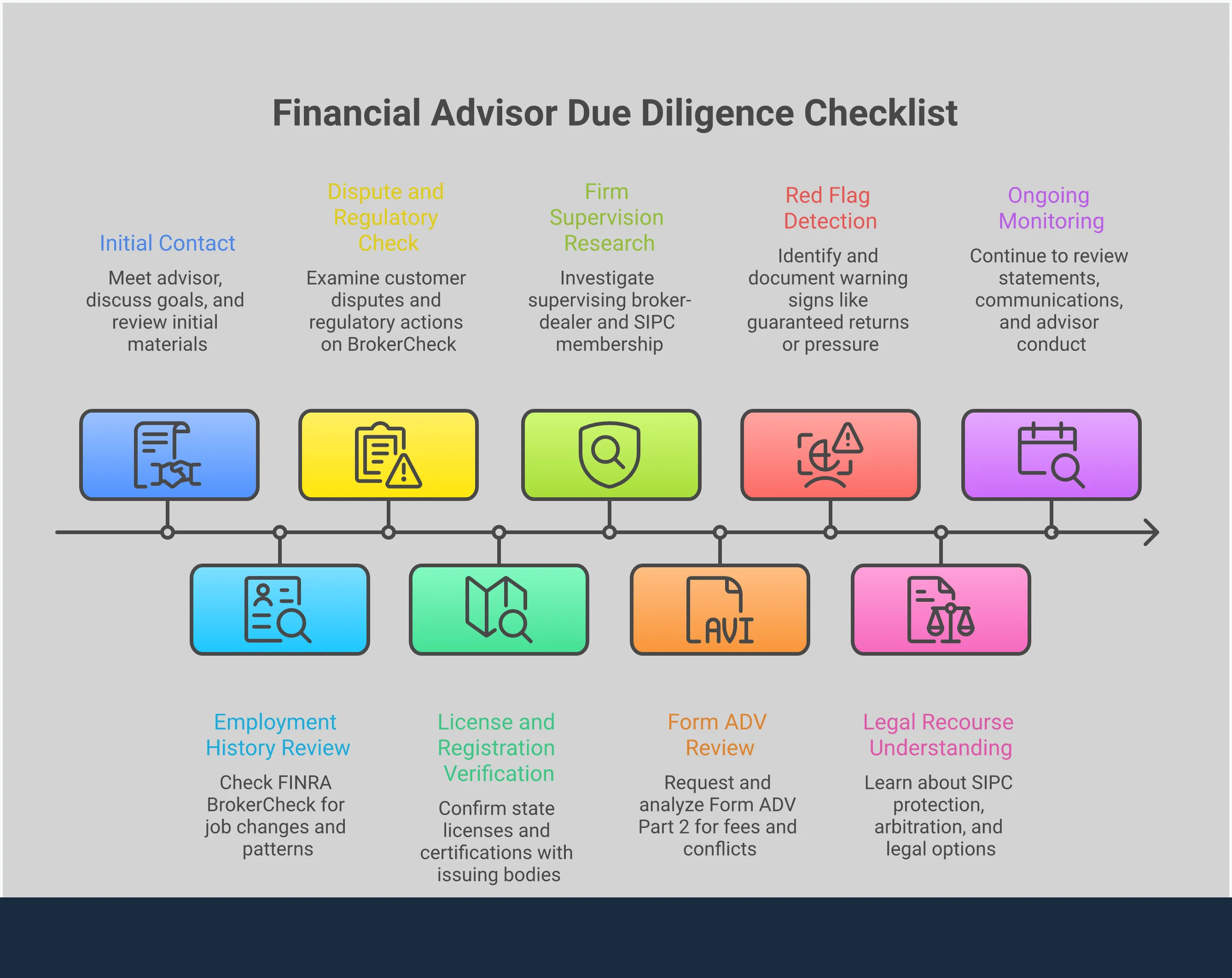
Essential Steps for Vetting an Advisor
Before signing any paperwork, take these crucial steps. First, verify the advisor’s qualifications. Look for key industry licenses, such as the Series 63 and Series 66 examinations, which are required for an advisor to provide investment advice in certain states. You can also check for certifications, and FINRA provides a great resource for understanding what different professional designations mean. Next, review their employment history. A stable work history can indicate reliability, while frequent job-hopping might be a reason to ask more questions. Finally, make sure the services they offer—like financial planning, portfolio management, or retirement consulting—align perfectly with your personal financial goals.
How to Spot Potential Red Flags
Knowing what to look for can help you steer clear of trouble. A major red flag is a lack of transparency. If an advisor is vague about their experience, how they are compensated, or their investment strategy, be cautious. Another warning sign is any claim that cannot be independently verified. Always use official sources to confirm their credentials and disciplinary history. Be wary of anyone who guarantees high returns or downplays risks; investing always involves risk, and promises of guaranteed profits are a hallmark of broker fraud and negligence. Finally, trust your gut. If you feel pressured to make a quick decision or invest in something you don’t understand, it’s okay to walk away.
How to Check an Advisor’s Background
Before you entrust anyone with your hard-earned money, doing your homework is non-negotiable. A thorough background check can reveal critical information about a financial professional’s history, qualifications, and any potential red flags. Think of it as your first line of defense in protecting your financial future. Fortunately, there are free and reliable public resources available that make this process straightforward.
Taking the time to vet an advisor isn’t about being distrustful; it’s about being a smart, informed investor. You have the right to know who you’re working with, including their employment history, how they’ve handled client relationships in the past, and whether they have faced any disciplinary actions. This information gives you a clearer picture and helps you make a confident decision. If you uncover anything that seems concerning, it may be a sign of potential broker fraud and negligence.
Using FINRA’s BrokerCheck Tool
Your first and most important stop should be FINRA’s BrokerCheck tool. This free resource allows you to search for information on current and former brokers, investment advisors, and financial firms. A quick search can provide a wealth of details, including a professional’s employment history over the last 10 years, their certifications, and the specific licenses they hold. Most importantly, BrokerCheck discloses any customer disputes, regulatory actions, or disciplinary history. It’s a comprehensive report that can immediately tell you if an advisor has a troubled past.
Other Resources for Your Research
While BrokerCheck is an excellent starting point, a simple online search can often fill in other details. You can find information about an advisor’s past employers, the specific services their firm offers, and the states where they are registered to provide investment advice. For example, a search might show that an advisor has passed the Series 63 and Series 66 examinations, which are state-level securities licenses. You might also find details about the types of services they provide, such as financial planning, portfolio management, or pension consulting. Combining these findings with the BrokerCheck report gives you a more complete understanding of the advisor you’re considering.
Related Articles
- Cetera Broker Patrick Siria: Investor Complaints & Allegations – The Frankowski Firm
- UBS Broker Kieran Varga: A Profile for Investors | The Frankowski Firm
- Morgan Stanley Broker Kenneth Maring: Investor Review – The Frankowski Firm
- Patrick Pistor (CRD# 7579589): What Investors Need to Know | The Frankowski Firm
Frequently Asked Questions
What’s the most important first step before hiring a financial advisor? The most critical step is to independently verify their background. Before you sign any agreements or transfer any funds, use free tools like FINRA’s BrokerCheck to review their employment history, licenses, and any past customer complaints or disciplinary actions. This simple check gives you a factual foundation to build on, separate from what the advisor tells you.
My advisor works for an independent firm like Centaurus Financial. What does that mean for me? When an advisor is with an independent firm, it means they run their own practice but use the firm’s platform for trading and compliance. While this structure is common, it’s important to remember that the firm is ultimately responsible for supervising your advisor’s conduct. If a problem arises from the advice you received, both the individual advisor and the firm could be held accountable.
I was told my account is protected by SIPC. Does that mean my investment is safe from bad advice? This is a common point of confusion. SIPC protection is designed to help you recover your cash and securities only if the brokerage firm itself fails financially. It does not protect you from investment losses, even if those losses were caused by unsuitable recommendations or poor advice from your advisor. It’s not a guarantee against losing money in the market or due to negligence.
What’s the quickest way to spot a potential red flag with an advisor? One of the biggest red flags is a lack of transparency or a sense of being rushed. If an advisor is vague about how they get paid, dismisses your questions about risk, or pressures you to make a quick decision, you should be cautious. Another major warning sign is any promise of guaranteed high returns, as all legitimate investing involves some level of risk.
What should I do if I suspect my advisor has given me bad advice and I’ve lost money? If you believe your losses are due to unsuitable recommendations or negligence, your first step is to gather all your account statements and correspondence with the advisor. The next step is to seek a professional opinion from a securities law firm. They can review your situation to determine if you have a valid claim and explain your options for recovering your losses, which often involves a process called securities arbitration.