Trusting a financial professional with your life savings is a significant act of faith. When you work with someone like Centaurus Financial, Inc. Broker Curtis Edmark, you expect your investments to be handled with care and your goals to be prioritized. But what happens when that trust begins to waver? Perhaps your account statements are confusing, the communication is lacking, or the investments chosen don’t seem to align with the conservative strategy you discussed. These feelings of uncertainty are valid and deserve answers. This article provides a clear-eyed look at Curtis Edmark’s professional background, the standards brokers are held to, and the critical red flags every investor should know.
Key Takeaways
- Prioritize Professional History Over Public Persona: A broker’s community involvement or charitable activities doesn’t guarantee their professional integrity. Focus your due diligence on their regulatory record, qualifications, and whether their investment advice is truly suitable for your financial situation.
- Recognize the Key Warning Signs of Misconduct: Stay alert for red flags like recommendations for investments that don’t match your risk tolerance, trades made without your permission, or a lack of transparency about fees. Clear and consistent communication is a right, not a privilege.
- Take Action by Documenting Everything: If you suspect something is wrong, start by creating a detailed record of all communications, statements, and transactions. This documentation is the foundation for holding a broker accountable, whether through a formal complaint or the securities arbitration process.
Who Is Curtis Edmark?
Understanding the background of any financial professional is a critical first step for an investor. Curtis Edmark is a broker affiliated with Centaurus Financial and also operates through Pioneer Financial Group. Based on his public profiles, he has built a career in financial services while also engaging in community-focused activities. It’s important for investors to have a clear picture of the professionals they entrust with their financial future, looking at both their professional roles and their broader activities.
His Role at Pioneer Financial Group
Curtis Edmark is a financial services and insurance professional with more than 28 years of experience. According to his professional biography, he works with Pioneer Financial Group, where he focuses on assisting retirees with their financial goals. His stated aim is to help clients improve their cash flow and grow their net worth. In this capacity, his work involves managing client assets and providing advice on various financial products. This role requires a deep understanding of different investment issues and a commitment to acting in a client’s best interest.
Community and Educational Involvement
Outside of his financial practice, Curtis Edmark is involved in educational and community initiatives. He has founded two financial aid programs: the Curtis Edmark Scholarship and the Curtis Edmark Grant. These programs are designed to offer financial assistance to students across the country who are pursuing higher education. He has expressed that supporting education is a meaningful way to contribute to society and help shape future generations. While community involvement can be a positive trait, investors should always focus on a broker’s professional conduct and regulatory history when making financial decisions.
What Services Does Curtis Edmark Offer Through Centaurus Financial?
When you work with a financial advisor, it’s important to understand exactly what services they provide. Through Centaurus Financial, Curtis Edmark offers a range of services focused on wealth management and retirement. Understanding these offerings is the first step in making sure your financial interests are being properly managed. Let’s look at what these services typically include and what you, as an investor, should know about each one.
Financial Planning and Investment Management
Curtis Edmark is described as a professional who “specializes in helping retirees increase cash flow and net worth.” This falls under the umbrella of financial planning and investment management. In practice, this means he should be creating a personalized strategy to help you meet your financial goals and then actively managing your investment portfolio to align with that strategy. A key part of this service is ensuring that any investment recommendations are suitable for your specific financial situation, risk tolerance, and long-term objectives. When a broker recommends investments that don’t fit your profile, it can be a sign of broker fraud and negligence.
Retirement and Insurance Planning
Centaurus Financial states that it “offers a full range of financial products and services” from established companies to help clients achieve their goals. This often involves retirement and insurance planning, which uses products like annuities, life insurance, and long-term care policies to build financial security for the future. The firm suggests this approach allows for “unbiased advice and options.” However, it’s always wise for investors to ask detailed questions about any product recommended to them. You should fully understand the fees, risks, and terms before committing, as many complex investment issues can arise from products that are not a good fit for your needs.
Access to Money Managers
According to Centaurus Financial, the firm “works with many top money managers,” giving clients access to these professionals with a much lower initial investment than might otherwise be required. This service connects you with a third-party manager who actively handles your portfolio. While this provides access to professional management, it also adds another layer to your financial relationships. You are placing trust in both your broker and the money manager they recommend. It’s essential to receive clear and regular communication about your portfolio’s performance and the fees you are paying. If a dispute arises with a broker or advisor, you may need to resolve it through securities arbitration.
What Are Curtis Edmark’s Qualifications?
When you hand over your hard-earned money to a financial advisor, you need to know who you’re dealing with. Understanding a broker’s qualifications, from their licenses to their industry experience, gives you a clearer picture of their professional background. These credentials show they’ve met the necessary requirements to offer investment advice and manage your accounts. Let’s take a look at the qualifications held by Curtis Edmark and what they mean for you as an investor.
Professional Licenses and Compliance
To work in the securities industry, brokers are required to pass exams and hold specific licenses. Curtis Edmark holds Series 7 and Series 66 licenses, which allow him to sell a wide variety of securities and act as an investment adviser. He is also registered to do business in several states, including Florida and Arizona. These licenses are more than just credentials; they signify a legal duty to act responsibly on behalf of a client. When a broker fails to uphold this responsibility, it can result in serious problems, including forms of broker fraud and negligence. It’s this accountability that is designed to protect you as an investor.
Commitment to Industry Standards
With a career spanning several decades, Curtis Edmark has significant experience in the financial services industry. Holding active licenses means he is subject to the rules and ethical standards established by regulators like the Financial Industry Regulatory Authority (FINRA). A core part of these standards is the requirement to make suitable investment recommendations that match a client’s financial situation, goals, and risk tolerance. If a broker recommends investments that are inappropriate or makes trades without permission, they may be violating these industry rules. When such disputes arise, they are typically resolved through a formal process known as securities arbitration.
What Are Curtis Edmark’s Philanthropic Activities?
Many financial professionals build their public profiles through community involvement and charitable work, and Curtis Edmark is no exception. He presents himself as a community-focused individual through several philanthropic efforts, primarily centered on education. While community support can be a positive trait, it’s important for investors to remember that a broker’s primary responsibility is to provide suitable financial advice and act in their clients’ best interests. A positive public image should never distract from a thorough evaluation of a broker’s professional conduct. Any concerns about broker fraud and negligence should be addressed based on their actions within your investment portfolio, not their activities outside of it. Edmark’s philanthropic work is mainly channeled through scholarships and local engagement.
Scholarship and Grant Programs
Curtis Edmark has established two financial aid initiatives for students in the United States: the Curtis Edmark Scholarship and the Curtis Edmark Grant. According to his website, these programs are intended to offer financial support to students working toward their college degrees. The stated goal is to help them achieve their academic ambitions and foster educational advancement. By creating these opportunities, Edmark positions himself as a supporter of education for the next generation. These programs form a key part of his public-facing philanthropic identity, highlighting a commitment to helping students manage the costs of higher education.
Community and Educational Support
Beyond specific scholarships, Curtis Edmark publicly states that he believes true success involves the positive impact one has on others. He emphasizes education as a powerful tool for contributing to society. His website also notes his active involvement in community engagement, where he reportedly collaborates with local organizations to support community well-being. This narrative of giving back is a common way for financial advisors to build trust. However, for investors, the most critical measure of a broker’s character is their professional integrity and how they handle their clients’ money and address various investment issues.
How Is Centaurus Financial Regulated?
Brokerage firms like Centaurus Financial operate within a structured regulatory system designed to protect investors. Understanding this framework can help you know what standards your broker is expected to meet and who holds them accountable. These rules are not just formalities; they are the safeguards intended to ensure your financial interests are handled with care and integrity. When you know the rules of the game, you’re in a much better position to spot when something isn’t right and to take action if your trust has been broken.
Oversight from FINRA, the SEC, and SIPC
Centaurus Financial is registered with and regulated by the Financial Industry Regulatory Authority (FINRA). As a self-regulatory organization, FINRA creates and enforces the rules that govern brokerage firms and their representatives. Its primary goal is to ensure the brokerage industry operates fairly and honestly. In addition to FINRA, the U.S. Securities and Exchange Commission (SEC) provides federal oversight of the entire securities industry, enforcing laws against market manipulation and fraud. If a dispute with a broker cannot be resolved directly, investors often turn to securities arbitration through FINRA to seek a resolution. Finally, the Securities Investor Protection Corporation (SIPC) provides limited protection for investors’ assets if a brokerage firm fails financially.
Compliance for Independent Broker-Dealers
As an independent broker-dealer, Centaurus Financial is not tied to a single company’s products, allowing its brokers to offer a wide variety of investment options. To manage client assets, the firm uses clearing firms like Pershing and Schwab for custody services, which is a standard practice in the industry. These partnerships are meant to add a layer of security for your investments. While these compliance structures and regulatory bodies are in place to safeguard investors, they don’t always prevent instances of broker fraud and negligence. It’s crucial for investors to remain vigilant and understand that these systems are the backstop, not a guarantee against individual misconduct.
What Are the Red Flags of Broker Misconduct?
Trusting someone with your financial future is a significant decision. While many financial professionals act in their clients’ best interests, it’s crucial to recognize the warning signs of broker misconduct. Being aware of these red flags can help you protect your investments and take action before serious damage occurs. These signs often revolve around a lack of transparency, questionable investment choices, and poor communication. If something feels off with your broker or your account, it probably is. Paying attention to these details is the first step in safeguarding your hard-earned money.
Unsuitable Investments and Unauthorized Trades
One of the most common signs of trouble is when a broker recommends investments that don’t fit your financial profile. An unsuitable investment is one that doesn’t align with your stated goals, risk tolerance, or age. For example, if you’re nearing retirement and need stable, low-risk assets, a broker pushing speculative stocks is a major red flag. Similarly, you should watch for unauthorized trading, which is when a broker makes trades in your account without your explicit permission. This is a serious violation of their duty to you. Always review your account statements carefully and question any transaction you didn’t approve. These actions can be clear indicators of broker fraud and negligence.
Excessive Fees and Poor Communication
Your investment returns can be significantly eroded by excessive fees and commissions. While brokers need to be compensated, the fees should be reasonable and fully disclosed. If you notice unusually high charges or find it difficult to get a clear breakdown of costs, it’s time to ask questions. This issue often goes hand-in-hand with poor communication. A broker who is difficult to reach, avoids your questions, or gives vague answers about your portfolio’s performance may not be acting in your best interest. You have a right to clear, consistent communication and straightforward answers about how your money is being managed. A professional relationship requires accountability and responsiveness.
Lack of Transparency
Transparency is the foundation of a healthy relationship with your financial broker. If your broker is secretive about their investment strategy, downplays risks, or promises guaranteed returns, you should be cautious. You should always have easy access to your account statements and receive clear explanations for every decision made on your behalf. A broker who makes it difficult to get information or seems evasive when you ask for details might be hiding something. This lack of openness can point to a range of investment issues, from hidden fees to outright misconduct. Always remember that your money is on the line, and you deserve complete clarity from the person managing it.
What Should You Do If You Suspect Misconduct?
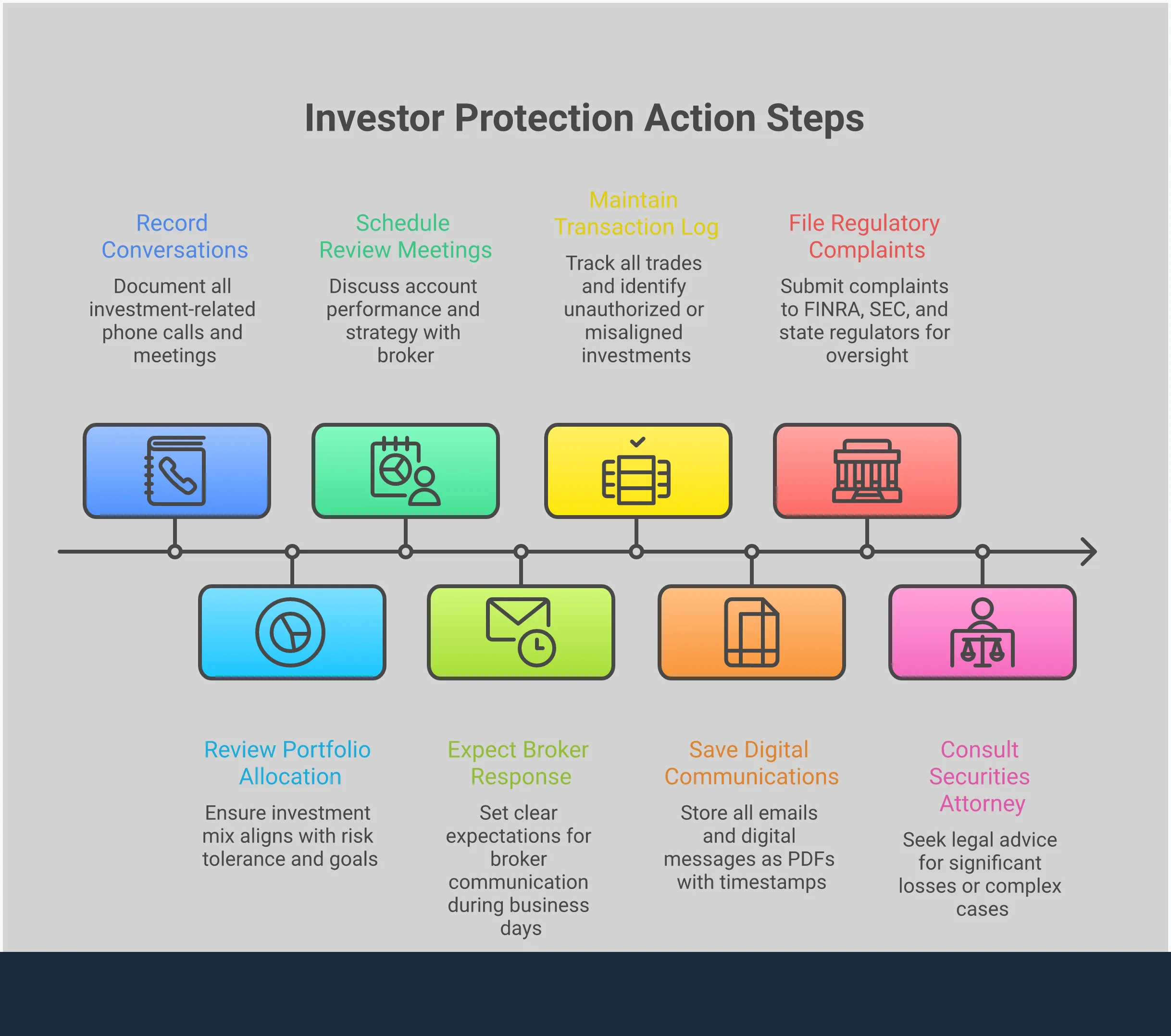
Realizing that your broker may have acted improperly with your investments can be incredibly unsettling. It’s easy to feel overwhelmed or even second-guess yourself, but taking a calm, methodical approach is the most effective way to protect your financial future. If your gut is telling you something is wrong, it’s time to listen and take action. The steps you take now can make a significant difference in the outcome of your case. You don’t have to have all the answers right away. The most important thing is to start by focusing on what you can control: gathering information and reporting the issue. This proactive stance helps you regain a sense of control and builds a solid foundation for holding the responsible parties accountable. Remember, you have rights as an investor, and there are established procedures for addressing potential wrongdoing. It’s not about being confrontational; it’s about seeking clarity and protecting the assets you’ve worked hard to build. The following steps will guide you through the initial process of addressing your concerns and seeking a resolution.
Document Everything and Gather Evidence
If you suspect misconduct, it is crucial to document everything related to the situation. This includes keeping records of all communications, transactions, and any other relevant information that could support your claims. Create a dedicated folder—digital or physical—and save every email, text message, and account statement. If you had phone calls, jot down the date, time, and a summary of the conversation right after you hang up. This paper trail creates a clear timeline and serves as concrete evidence. Strong documentation is the foundation of any successful claim related to broker fraud and negligence.
File a Complaint with Regulators
You can file a complaint with regulatory bodies such as the Financial Industry Regulatory Authority (FINRA) or the Securities and Exchange Commission (SEC). These organizations are responsible for overseeing brokers and can investigate claims of misconduct. Think of them as the financial industry’s watchdogs. Filing a formal complaint can trigger an investigation into your broker’s practices and creates an official record of your dispute. While you can submit a complaint on your own, the process can be complex. Understanding your rights and the potential for securities arbitration is an important part of recovering your losses.
How Can The Frankowski Firm Help?
Discovering that your broker may have mishandled your investments can be a stressful and isolating experience. You trusted someone with your financial future, and now you’re left with more questions than answers. At The Frankowski Firm, we understand what you’re going through. Our entire practice is built around standing up for investors and holding financial professionals accountable for their actions. We are dedicated to helping you understand your options and pursuing the recovery of your losses.
When you’re up against a large brokerage firm like Centaurus Financial, it can feel like an unfair fight. They have teams of lawyers and extensive resources at their disposal. Our role is to level the playing field. With more than two decades of experience focused specifically on investment and securities fraud, we have the knowledge to handle complex claims nationwide. We take a detailed and personalized approach to every case, ensuring we understand the specifics of your situation and can build the strongest possible argument for you. You don’t have to face this alone. We are here to be your advocates and guide you through the legal process, providing clear communication and support every step of the way. Our commitment is to you, the investor, and we work tirelessly to see that your voice is heard and your interests are protected.
Representing You in Securities Arbitration
Most disputes between investors and brokerage firms are resolved through a process called securities arbitration, which is typically overseen by the Financial Industry Regulatory Authority (FINRA). This is a mandatory process outlined in the fine print of the account agreements you sign. Our attorneys are deeply familiar with the specific rules and procedures of the FINRA arbitration forum. We will handle every step for you, from filing the initial claim and gathering critical evidence to presenting a compelling case on your behalf at the hearing. Our goal is to clearly demonstrate how your broker’s misconduct led to your financial losses and to fight for the compensation you deserve.
Protecting Your Rights as an Investor
As an investor, you have fundamental rights. You have the right to receive investment recommendations that are suitable for your financial situation and goals. You have the right to authorize every transaction in your account. And you have the right to honest and transparent communication from your broker. When these rights are violated through actions like unsuitable recommendations or unauthorized trading, it constitutes broker fraud and negligence. Our firm is committed to protecting these rights. We work to hold brokers and their firms accountable for their failures, helping you reclaim control of your financial well-being. If you believe your rights have been violated, please contact us for a confidential consultation.
How Can You Contact Curtis Edmark?
If you need to reach Curtis Edmark, his professional practice is conducted through Pioneer Financial Group. Whether you’re a current client reviewing your accounts or someone looking into your past investment relationship, knowing the official channels for communication is the first step. The information below outlines the publicly available methods for contacting his office, based on what his firm provides on its website. This gives you a clear and direct path for making contact without any guesswork.
Contacting Pioneer Financial Group
Curtis Edmark is registered with Pioneer Financial Group, an independent financial services company located in Greenfield, Wisconsin. According to its website, the firm focuses on helping people manage their finances and plan for retirement. If you are trying to reach Curtis Edmark directly, the most straightforward way is to go through his firm. You can find office details and other relevant information on the official Pioneer Financial Group website. This is the primary source for the contact information provided by the company and the best place to start if you need to get in touch with him or his team.
How to Get Started
For individuals interested in beginning a professional relationship with Curtis Edmark, his firm outlines a specific process. Pioneer Financial Group offers a free guide titled “5 Steps to Retirement!” to prospective clients who fill out a form on their website. This is presented as the initial step for anyone looking to learn more about their retirement planning services. The firm encourages this method as the first point of contact for new inquiries and for distributing their introductory materials. Following this procedure is the established way to initiate a conversation about their services, as described by the firm itself.
Related Articles
- Broker Fraud and Misconduct: Signs and Red Flags – The Frankowski Firm
- MICHAEL TODD FIRED BY CENTAURUS FINANCIAL FOLLOWING CUSTOMER COMPLAINTS – The Frankowski Firm
- The Process of Securities Arbitration Explained – The Frankowski Firm
- Edward Jones Broker Joshua Marino (CRD# 6141373): Investor Guide | The Frankowski Firm
- UBS Broker Kieran Varga: A Profile for Investors | The Frankowski Firm
Frequently Asked Questions
My broker is very involved in the community. Doesn’t that mean they’re trustworthy? It’s great when professionals give back to their communities, but that should be viewed separately from their professional responsibilities. A broker’s primary duty is to manage your money with your best interests at heart. The true measure of their trustworthiness is found in their professional conduct—things like providing clear communication, recommending suitable investments, and being transparent about fees. A positive public image doesn’t replace the need for professional integrity.
What does an “unsuitable investment” actually look like? An unsuitable investment is simply one that doesn’t match your personal financial situation, goals, or tolerance for risk. For example, if you’re a retiree who needs to preserve your capital and generate steady income, placing your nest egg in a highly speculative or volatile investment would be considered unsuitable. Your investment strategy should be tailored to you, and any recommendation that ignores your specific needs is a major red flag.
How can I tell if my losses are from normal market risk or from broker misconduct? All investments carry some level of risk, and markets will always have their ups and downs. The key difference is the reason behind your losses. If your portfolio’s value drops along with a general market downturn, that’s typically considered market risk. However, if your losses are the result of unauthorized trades, excessive fees, or investments that were far too risky for your stated goals, then misconduct may be the cause.
My account agreement mentions arbitration. Does that prevent me from taking legal action? Not at all. That clause simply means that any dispute you have with the firm must be resolved through a specific legal process called securities arbitration, usually handled by FINRA, instead of in a traditional courtroom. It is a formal and binding process where you can present your case to recover your losses. You absolutely have the right to pursue a claim through this channel.
I suspect something is wrong with my account, but I feel overwhelmed. What is the very first step I should take? The best first step is to start gathering your documents. Collect all of your account statements, trade confirmations, and any emails or letters you have exchanged with your broker. If you had phone calls, write down what you remember about those conversations. Organizing this information gives you a clear picture of what happened and creates a solid foundation if you decide to pursue a claim.