
+1-888-741-7503
NO FEES UNTIL WE WIN
FREE CONSULTATION
NO FEES UNTIL WE WIN
FREE CONSULTATION
Financial advisors have a professional duty to recommend investments that are in your best interest. But what happens when a product offers them a high commission? This conflict of interest is a serious problem when it comes to High- Risk Auto-Callable Structured Notes. These products are often lucrative for the brokers who sell them, which can lead to recommendations that don’t align with a client’s financial goals or risk profile. It’s crucial to understand that your advisor’s gain could be directly tied to your potential loss. We’ll explore the mechanics of these notes, the red flags of a bad recommendation, and how to determine if you’ve been a victim of broker fraud driven by hidden incentives.
Auto-callable structured notes are complex investment products tied to the performance of an underlying asset, like a stock or a market index. Brokers often present them as a way to earn higher returns than traditional bonds while offering some protection for your initial investment. They might promise regular interest payments, or “coupons,” and the return of your principal at maturity. However, these promises come with significant strings attached.
The structure of these notes can be confusing, and their performance depends on meeting very specific market conditions. If the underlying asset performs well, you might get the returns you were told to expect. But if it doesn’t, you could face substantial losses. Their complexity makes them one of the more challenging investment issues for individual investors to fully understand. It’s so important to look past the sales pitch and see how these notes really work before putting your money on the line.
The “auto-callable” feature is the main event here. It means the investment can end early, before its official maturity date. The note has set “observation dates”—maybe quarterly or annually—where the issuer checks the price of the underlying asset. If the asset’s price is at or above a predetermined “autocall level” (often its initial price) on one of these dates, the note is automatically “called.” When this happens, the investment is over. You get your original principal back, plus any coupon payments you’ve earned. If the asset’s price stays below that level on the observation dates, the note continues, and your money remains invested and at risk.
Let’s be direct: despite how they may be presented, auto-callable notes are high-risk investments. The biggest danger is the potential to lose some or all of your principal. These notes have a “barrier level,” which is a downside safety net. If the underlying asset’s price drops below this barrier, that safety net disappears, and your investment is directly exposed to the losses. You could lose a significant portion of your money if the asset performs poorly. Their complexity is another major risk factor; it’s easy to misunderstand the terms, especially if a broker fails to explain the downsides. This failure to disclose risk is a serious form of broker fraud and negligence.
Those coupon payments you were promised are not guaranteed. They are entirely dependent on the performance of the underlying asset. If the asset’s value is below a certain level on a payment observation date, you may not receive your coupon for that period. The value of the note itself is also sensitive to many factors, including changes in stock prices, interest rate shifts, and general market volatility. If the underlying asset performs poorly, you could face a double hit: the coupon payments can stop, and the value of the note itself can fall sharply, leaving you with an investment worth far less than what you paid for it.
Auto-callable structured notes are often presented as an innovative way to get stock market-like returns with less risk. The sales pitch can be tempting: you get regular coupon payments and the chance for your note to be “called” early, returning your principal plus a profit. However, these complex products carry substantial risks that are frequently downplayed or poorly explained. The truth is, the features designed to generate high yields are the very same ones that can lead to significant financial losses.
Understanding these risks is the first step in protecting your portfolio. Unlike straightforward investments like stocks or bonds, auto-callable notes have intricate structures with conditional clauses and triggers that can be difficult for even seasoned investors to follow. The potential for losing your principal, the impact of market swings, the creditworthiness of the issuer, and the difficulty of selling your note are all critical factors to consider. Before you even think about investing in one of these products, it’s important to look past the marketing and see how they actually work—and what can go wrong.
The most significant risk with auto-callable notes is the potential to lose some or all of your initial investment. While they are often marketed with “principal protection” features, this protection is not guaranteed. It’s conditional and typically disappears if the underlying asset—like a stock or an index—drops below a predetermined price, known as a barrier. If this happens, you could be left holding an asset that has plummeted in value, and your losses could be substantial. These are not safe investments and are especially unsuitable for retirees or anyone seeking to preserve their capital and generate a steady income.
The performance of an auto-callable note is directly tied to the ups and downs of the market. The value of the note can be swayed by shifts in stock prices, interest rates, and general market volatility. While a broker might present these notes as a way to get steady returns in a choppy market, high volatility can actually work against you. It can increase the chance that the underlying asset will hit the downside barrier, putting your principal at risk. When a financial advisor fails to explain how market swings can impact these complex investment issues, they may be putting your financial future in jeopardy.
Many investors don’t realize that when you buy an auto-callable note, you are essentially lending money to the financial institution that issued it, such as a large investment bank. This means you’re exposed to the issuer’s credit risk. If the issuing bank or company faces financial distress or declares bankruptcy, it may be unable to make coupon payments or return your principal at maturity. In a worst-case scenario, you could lose your entire investment, even if the underlying asset performed well. This risk exists completely separate from the market performance of the note itself.
Auto-callable notes are considered “illiquid” investments. Unlike stocks, which you can sell easily on any business day, there is no active secondary market for most structured notes. If you need to access your money before the note matures, you may find it very difficult to find a buyer. If you do manage to sell, it will likely be at a significant discount to the note’s estimated value. This lack of flexibility means your money is tied up for the full term of the note, which can be a serious problem if your financial circumstances change unexpectedly.
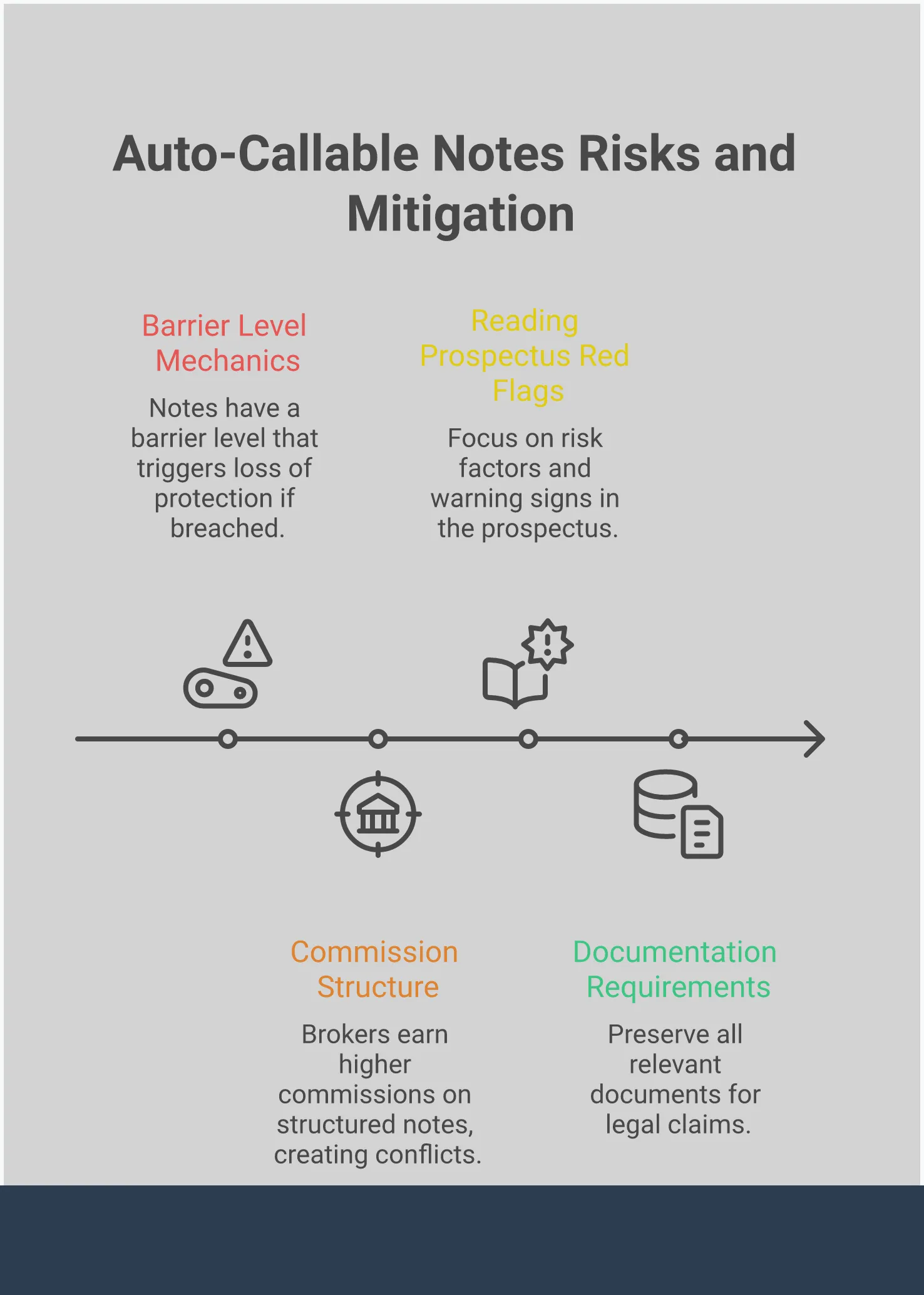
The “protection” in these notes is tied to a feature called a barrier level. Think of it as a floor for the underlying asset’s price. The note promises to return your principal unless the asset’s price drops below this barrier. If it does, a “knock-in event” is triggered, and the protective feature vanishes. At that point, you become fully exposed to the downside performance of the asset. If the asset has fallen 50% below its initial level, you will lose 50% of your principal. This is a critical detail that is often buried in the fine print, a common tactic in cases of broker fraud and negligence.
Auto-callable structured notes are often presented as the best of both worlds: the high returns of the stock market with the safety of a bond. This appealing pitch can be very persuasive, but it often glosses over the significant risks involved. Unfortunately, some financial advisors may downplay the complexity and potential for loss, leading investors to believe these products are much safer than they actually are. When a broker misrepresents an investment, it can be a form of broker fraud and negligence.
Understanding the truth behind these products is crucial for protecting your financial health. Let’s clear up some of the most common and costly myths surrounding auto-callable notes so you can see them for what they are: complex, high-risk investments. By getting past the sales pitch, you can better assess whether these notes have any place in your portfolio and recognize when a recommendation might not be in your best interest.
One of the most dangerous misconceptions about auto-callable notes is that your initial investment is protected. While some notes are marketed with “principal protection,” this protection is almost always conditional. It typically depends on the performance of an underlying asset, like a stock or an index. If that asset’s value drops below a predetermined “barrier level,” your principal is suddenly at risk. You could lose a significant portion, or even all, of your original investment. The bottom line is that auto-callable notes do not offer the same safety as a certificate of deposit (CD) or a traditional bond; your principal is not guaranteed.
The high coupon rates offered by auto-callable notes are incredibly tempting, but these payments are far from guaranteed. Each payment is contingent on the underlying asset meeting a specific price level on a set observation date. If the asset performs poorly and fails to reach that level, you won’t receive a coupon payment for that period. If the poor performance continues, the payments can stop altogether, and the note’s value can drop dramatically. The promise of a high return is just that—a promise, not a guarantee. It’s entirely dependent on market conditions you can’t control.
Despite how they might be pitched, auto-callable notes are anything but simple. They are complex structured products with multiple moving parts, including call dates, barrier levels, coupon triggers, and underlying assets. Understanding how all these features interact to determine your return—or your loss—requires a deep dive into the prospectus. Many investors are unaware of the intricate risks embedded in these notes, making them susceptible to significant losses. These types of complex investment issues often arise when the product’s structure is too confusing for the average investor to fully grasp before putting their money on the line.
If the underlying asset performs well, the note may be “called,” or redeemed early by the issuer. While this means you get your principal back plus any coupon payments you’ve earned, it isn’t always the best outcome. An early call effectively puts a cap on your potential gains. If the underlying asset continues to soar in value after the note is called, you miss out on all of that future growth. You’re left with a relatively small, fixed return, while investors who owned the asset directly could be seeing much larger profits.
When a broker presents an auto-callable structured note, they might frame it as the perfect middle ground between the safety of bonds and the growth potential of stocks. This comparison, however, can be dangerously misleading. While these notes are linked to familiar assets, they operate under a completely different and far more complex set of rules. Understanding these distinctions is critical before you consider adding them to your portfolio.
Traditional investments like stocks and bonds have straightforward risk-and-reward profiles. When you buy a stock, you own a piece of a company; its value rises or falls with the company’s fortunes. When you buy a corporate bond, you are essentially lending money in exchange for regular interest payments and the return of your principal at a set date. Auto-callable notes don’t fit neatly into either category. They are debt instruments with embedded derivatives, meaning their performance is tied to a complex formula. This structure creates unique risks that are often downplayed, leaving investors to sort through a variety of investment issues they never anticipated.
At first glance, the periodic “coupon” payments from an auto-callable note might look like the interest payments from a corporate bond. But that’s where the similarity ends. Corporate bonds are designed to be relatively stable; they provide predictable income and are expected to return your full principal at maturity, assuming the issuer doesn’t default.
Auto-callable notes are a different story. They may offer higher potential returns, but they come with a much greater risk of investment loss. Unlike most bonds, they don’t guarantee full principal protection. If the underlying asset performs poorly and drops below a predetermined barrier, you could lose a significant portion, or even all, of your initial investment. The coupon payments are also conditional and can stop entirely if the asset’s performance doesn’t meet specific criteria.
Brokers sometimes pitch auto-callable notes as a way to participate in the stock market with less risk. While these notes are often linked to the performance of a stock or a stock index, they are not stocks. When you buy a stock, you gain ownership in a company and have unlimited potential for growth. An auto-callable note offers no ownership rights.
Furthermore, your potential gains are almost always capped. Even if the underlying stock skyrockets, your return is limited to the predetermined coupon payments. These products are known for offering high potential yields, but they do so by embedding complex risk. You take on the downside risk of the stock market without getting to participate in the full upside, a trade-off that isn’t always made clear.
Proponents of structured notes claim they can help manage market volatility, offering a degree of downside protection while capturing some upside. While this may be true in very specific, favorable market conditions, the reality for many investors is quite different. The complex structure of these notes often obscures a risk-return profile that is heavily skewed in favor of the issuing bank.
The formulas that determine your payout are intricate, and the conditions for losing your principal can be triggered by short-term market dips. For many investors, the capped potential gain simply doesn’t justify the substantial risk of loss. When a financial advisor fails to properly explain this dynamic, it can be a sign of broker fraud and negligence. A suitable investment recommendation requires a full and honest disclosure of the risks involved.
Before you put any money into an auto-callable structured note, it’s vital to do your homework. These are complex products, and understanding the fine print can be the difference between a calculated risk and a devastating loss. Taking the time to review the documentation, understand the costs, and honestly assess your own financial situation will help you make a more informed decision. Focus on these three key areas to get a clearer picture of what you’re getting into.
The prospectus is the official document that details everything about the structured note. It’s not exactly light reading, but it contains critical information you need to know. Investors should carefully review the prospectus of auto-callable structured notes, as it explains the product’s structure, risks, and potential returns. This document outlines the specific terms and conditions, including the underlying asset, barrier levels, and call dates. Understanding these details is essential for making a sound decision about these complex investment issues. Don’t just take your broker’s word for it—read it yourself.
Fees can quietly eat away at your returns, and with structured notes, they can be layered and complex. The fee structure associated with auto-callable notes can significantly impact your overall profit. You need to be aware of any upfront costs, ongoing management fees, and how these charges are calculated. Sometimes, these costs are built into the product’s price, making them harder to spot. Ask for a clear breakdown of all fees and consider how they will affect your potential gains before you commit. Misrepresenting these costs can be a form of broker fraud and negligence.
Structured notes are not suitable for everyone. They are designed for investors who can tolerate higher risks and have specific financial goals. It is crucial to assess your own risk tolerance before considering these products. Ask yourself if you’re comfortable with the possibility of losing your entire principal investment. Before you invest, consider whether the note aligns with your financial objectives and your outlook on the market. If a broker pushes a high-risk product that doesn’t match your profile, it may be an unsuitable recommendation. If you have questions, it’s always a good idea to contact a legal professional for guidance.
When you’re working with a financial professional, it’s easy to assume they have your best interests at heart. While many do, it’s crucial to stay vigilant, especially when complex products like auto-callable structured notes are on the table. These investments can be a source of high commissions for brokers, which can sometimes lead to recommendations that benefit them more than you. Trusting your intuition is important; if an investment opportunity feels rushed, confusing, or too good to be true, it’s worth taking a step back to look for warning signs.
Understanding the common red flags can help you protect your portfolio and make more informed decisions. A broker’s job is to provide clear, honest, and suitable advice that aligns with your financial goals, age, and comfort with risk. When their recommendations stray from your needs, or when they downplay risks and pressure you to act quickly, it’s a signal that something isn’t right. Being aware of these tactics is the first step in safeguarding your financial future from potential broker fraud and negligence.
One of the biggest red flags is a recommendation that doesn’t fit your financial profile. Auto-callable structured notes are complex and carry significant risk, making them unsuitable for most everyday investors. As one source notes, “They are not suitable for most regular investors, especially those who are retired, don’t like a lot of risk, or have only a moderate risk tolerance.” If you’ve told your advisor that you need to preserve your capital or have a low-to-moderate risk tolerance, a suggestion to invest in these notes should raise immediate concerns. Financial professionals have a duty to recommend investments that are appropriate for your specific circumstances, and failing to do so is a serious breach of trust.
A trustworthy advisor will walk you through both the potential rewards and the potential risks of any investment. With auto-callable notes, the risks are substantial, including the possibility of losing your entire principal. Because these products are so complicated, “investors often don’t realize the full extent of the risks until they’ve already lost money.” Your broker has a professional and legal obligation to explain these dangers clearly. If they gloss over the downsides, use confusing jargon to deflect questions, or focus only on the best-case scenarios, they are not giving you the full picture. This lack of transparency can be a sign of broker misconduct and may be grounds for legal action if you suffer losses.
Always ask how your advisor is being compensated for an investment recommendation. Auto-callable structured notes are known for their high costs, as “brokers who sell these notes often earn large commissions and fees.” This can create a powerful conflict of interest, motivating an advisor to push a product that pays them well, even if it’s not the right choice for you. If your advisor is vague about the fee structure or you notice unusually high costs buried in the prospectus, proceed with caution. Full transparency about fees is essential, and any reluctance to provide a clear breakdown is a major red flag for potential investment issues.
Feeling rushed into making an investment decision is a classic warning sign. A financial professional should give you ample time to review documents, ask questions, and consider your options. Tactics like creating a false sense of urgency or suggesting an offer is only available for a limited time are designed to prevent you from doing your due diligence. Remember, “investment firms and advisors are supposed to check these products carefully and make sure they are suitable for your age and financial situation before recommending them.” If you feel pressured to sign paperwork or transfer funds immediately, it’s time to pause. A legitimate opportunity will still be there after you’ve had time to think it over.
Taking control of your financial future means being an active participant in your investment decisions, not a passive observer. While financial advisors play a key role, it’s your money and your future on the line. Protecting yourself starts with a simple but powerful principle: never invest in anything you don’t fully understand. This is especially true for complex products like auto-callable structured notes, which are often wrapped in confusing jargon and optimistic projections. A healthy dose of skepticism is your best defense.
Before you commit any funds, ask probing questions and expect clear, straightforward answers. If a broker seems evasive, pressures you for a quick decision, or dismisses your concerns, consider it a major red flag. It’s crucial to understand all the potential outcomes, not just the best-case scenario your broker might be highlighting. Remember that you have the right to take your time, review documents thoroughly, and seek a second opinion. Being a vigilant and informed investor is the most effective way to safeguard your assets from unsuitable recommendations and other common investment issues. Your financial security is too important to leave entirely in someone else’s hands.
Doing your due diligence simply means doing your homework before you invest. For structured notes, this is non-negotiable. You should thoroughly understand the terms and conditions, including the underlying assets, the specific risks involved, and the issuer’s creditworthiness. Start by reading the prospectus—don’t just skim it. Pay close attention to the sections on risk factors and fees. If you don’t understand the language, ask your financial advisor to explain it in simple terms until you do. Research the underlying stock or index it’s tied to. Is it a stable blue-chip company or a volatile, lesser-known entity? This single detail can dramatically change the risk profile of the note.
You’ve likely heard the saying, “Don’t put all your eggs in one basket.” This is the core idea behind diversification, and it’s a fundamental strategy for managing investment risk. Incorporating a high-risk product like a structured note, if at all, should be done within a broadly diversified investment strategy to help soften the blows from market volatility. These products should never make up the bulk of your portfolio. A well-constructed portfolio includes a mix of different asset classes, like stocks, bonds, and cash, that align with your financial goals and risk tolerance. You can learn more about building a resilient portfolio by reviewing the SEC’s guidance on diversifying your portfolio.
Investing isn’t a one-and-done activity. It’s essential to check in on your portfolio regularly, especially when it contains complex products. Regularly reviewing the performance of your structured notes and their underlying assets is crucial for making informed decisions. Get in the habit of reading your account statements every month. Check for unexpected fees, unauthorized trades, or performance that drastically differs from what you were told to expect. If the underlying asset is nearing a barrier level, you need to know. If you notice discrepancies or your advisor can’t give you a clear explanation, it could be a sign of broker fraud and negligence. Staying engaged is your best tool for catching problems early.
It’s a terrible feeling to realize that an investment you were told was a good idea has resulted in significant losses. When it comes to complex products like auto-callable structured notes, it’s not always just bad luck in the market. Sometimes, the way the investment was sold to you crosses a line. If you suspect that the risks weren’t properly explained or that the product was misrepresented, it’s important to understand that you have rights as an investor.
Financial professionals have a duty to act in your best interest. When they fail to do so, whether through intentional deception or carelessness, you don’t have to accept the losses without a fight. The key is to recognize the signs of misconduct and know what steps you can take to hold the responsible parties accountable. Exploring your options can help you determine if you have a path to recovering your hard-earned money.
Securities fraud can take many forms, but with auto-callable notes, it often involves misrepresentation or omission of key facts. A broker might downplay the significant risks, such as the potential loss of your principal, or overstate the likelihood of a high return. They might describe the investment as “safe” or “principal-protected” when it is anything but. Because these notes are so complex, it’s easy for a financial advisor to gloss over the details of how market volatility or the issuer’s credit risk could impact your investment. These are not just poor sales tactics; they can be serious investment issues that constitute fraud. If you lost money because you weren’t given the full picture, you may have been a victim of fraud.
Even if a broker doesn’t intentionally mislead you, they can still be held liable for negligence. Financial advisors have a responsibility to recommend only “suitable” investments that align with your financial situation, goals, and risk tolerance. Pushing a high-risk, speculative product like an auto-callable note on a retiree who needs stable, income-generating investments is a classic example of an unsuitable recommendation. This type of broker fraud and negligence is a breach of their professional duty. If your advisor failed to adequately explain the risks or recommended an investment that was clearly inappropriate for you, you may have grounds for a claim to recover your losses.
If you believe you’ve lost money due to fraud or negligence involving auto-callable notes, your primary course of action is to file a claim. Most disputes between investors and brokerage firms are resolved through a process called securities arbitration, which is handled by the Financial Industry Regulatory Authority (FINRA). This is a formal legal process, and it is highly recommended that you don’t go through it alone. The first and most important step is to consult with a law firm that specializes in these specific types of claims. An experienced attorney can evaluate your case, explain your options, and build a strategy to help you recover your losses. Don’t hesitate to contact us for a review of your situation.
It can be incredibly disheartening to see your investment lose value, especially when you trusted a financial professional to guide you. With complex products like auto-callable structured notes, it’s often hard to know if the loss was just bad luck or something more. If your gut tells you something isn’t right, it’s worth listening. You don’t have to figure this out alone, and you shouldn’t have to.
Many investors feel intimidated or unsure if their situation warrants legal action. They might worry about the cost or the complexity of the process. But when significant money is lost in high-risk investments, it’s crucial to understand your rights. A broker’s job is to recommend investments that are suitable for your financial situation and risk tolerance. This is known as the suitability rule. If they fail to do that, or if they don’t fully explain the risks involved, they may be held responsible for your losses. Exploring your legal options is a proactive step toward protecting your financial future and holding the right people accountable. It’s not about assigning blame; it’s about seeking fairness and recovering what you’ve lost due to potential misconduct.
Recognizing the signs of a problem is the first step. If you lost money in auto-callable structured notes, that alone is a reason to look closer. These are high-risk products that aren’t suitable for many investors. A major red flag is if your broker downplayed the potential for loss or failed to explain how the note worked in simple terms. Did they pressure you into the investment? Did they over-concentrate your portfolio in these notes? These are all signs of potential broker fraud and negligence. If you feel that the risks weren’t made clear or the investment didn’t align with your goals, it’s time to ask more questions.
If you have a dispute with your stockbroker or their firm, you typically can’t just sue them in court. Instead, most investor claims are resolved through a process called securities arbitration. This is a formal proceeding where both sides present their case to an impartial arbitrator or panel, who then makes a binding decision. If you lost money because your financial advisor made a mistake, was careless, or recommended an unsuitable investment without explaining the dangers, you may have a strong case for compensation. The securities arbitration process is designed specifically to handle these types of investment disputes and help investors recover their losses.
The most direct way to find out if you can recover your losses is to speak with an investment fraud lawyer. A law firm with a focus on securities law can review your specific situation, analyze your account statements, and determine if you have a valid claim. They understand the complexities of products like auto-callable notes and know what to look for. You don’t have to be certain that fraud occurred to have this conversation. A consultation can provide clarity on your rights and the potential paths forward. If you’ve lost money and suspect something was wrong, the best thing you can do is contact a legal professional for a case evaluation.
Are auto-callable notes ever a good investment? While these notes are designed for a very specific type of investor with a high tolerance for risk and a deep understanding of complex financial products, the reality is they are often sold to people who don’t fit that description. The main issue isn’t just the product itself, but how it’s misrepresented. If you’re an investor focused on preserving your capital or generating steady income, like a retiree, these notes are almost always an inappropriate and high-risk choice.
My broker said my principal was “protected.” How could I still lose money? This is one of the most common and dangerous misconceptions. The “protection” on these notes is conditional, not guaranteed. It only works if the underlying asset stays above a specific price, often called a “barrier level.” If the asset’s price drops below that barrier, even for a short time, the protection can vanish completely, leaving your entire principal exposed to market losses.
What’s the difference between an auto-callable note and just buying the stock it’s linked to? When you buy a stock, you have unlimited potential for growth if the company does well. With an auto-callable note, your potential gains are capped at the coupon payments. If the underlying stock performs spectacularly, you won’t see any of that extra growth. In exchange for that capped upside, you get a conditional downside protection that can disappear when you need it most, leaving you with all the risk of owning the stock but none of the unlimited reward.
I’ve already lost money on one of these notes. Is it too late to do anything? It’s definitely not too late to explore your options. Many investors don’t realize something was wrong with the recommendation until after they’ve suffered losses. The first step is to have your situation reviewed by a legal professional who focuses on these specific types of investment disputes. They can help you understand if the losses were due to misconduct or an unsuitable recommendation.
How can I tell if my advisor’s recommendation was unsuitable for me? Think back to your conversations about your financial goals. Did you tell your advisor that you had a low-to-moderate risk tolerance or that your primary goal was to preserve your savings for retirement? Financial professionals have a duty to recommend investments that align with your stated objectives. If they pushed a complex, high-risk product like an auto-callable note despite you asking for safety and stability, that is a strong sign the recommendation was unsuitable.