
+1-888-741-7503
NO FEES UNTIL WE WIN
FREE CONSULTATION
NO FEES UNTIL WE WIN
FREE CONSULTATION
It’s a deeply unsettling feeling to discover that the person you trusted with your financial future may have put their own interests first. When a broker recommends an “exclusive” deal that operates outside their firm’s official channels, they are not only breaking the rules but also exposing you to immense risk. This practice, known as “selling away,” is a serious form of misconduct. A recent example brings this issue into sharp focus, as LPL Financial, LLC broker Michael Graham is the subject of a customer dispute alleging “selling away.” This situation underscores the importance of knowing your rights. If you’ve found yourself in a similar position, you are not alone, and you have legal options to pursue financial recovery and hold responsible parties accountable.
When you place your financial future in the hands of an advisor, you’re placing a significant amount of trust in their judgment and integrity. You expect them to recommend sound investments and guide you toward your goals. But what happens when that trust is broken? The case of Michael Clifford Graham, a former LPL Financial broker, is a stark example of what can go wrong. He is currently at the center of serious customer allegations that paint a picture of misconduct and disregard for client interests. These claims involve recommending unsuitable investments and, more critically, a practice known as “selling away”—directing clients to private investments that were not approved or supervised by his firm.
This type of behavior can constitute serious broker fraud and negligence, as it bypasses the safeguards firms are required to have in place to protect you. Brokerage firms have a duty to supervise their representatives to ensure they are complying with industry rules and regulations. When a broker steps outside of these approved channels, they are operating without that critical oversight, exposing their clients to potentially high-risk or fraudulent ventures. For any investor, understanding the details of a case like this is crucial. It not only sheds light on the specific actions of one broker but also highlights the red flags that all investors should be aware of to protect their hard-earned money. The allegations against Michael Graham serve as an important reminder that diligence is key, and knowing your rights is your best defense.
The core of the issue lies in a customer complaint filed in early 2025. According to the claim, an investment made back in 2023 was unsuitable for the client’s financial situation and risk tolerance. More seriously, the complaint alleges that Graham engaged in “selling away.” This means he recommended and sold private investments that were not vetted or approved by his employer, LPL Financial. This is a major violation of industry rules because it sidesteps the firm’s required oversight process, which is designed to protect investors from exactly these kinds of unvetted deals. Adding weight to the customer’s claims, reports indicate that LPL Financial terminated Graham’s employment for failing to disclose these exact types of outside business activities.
The financial impact of these alleged actions is significant. The client who filed the complaint in January 2025 is seeking to recover $276,200 in damages. This isn’t an isolated incident; another pending customer dispute is requesting $300,000 in losses related to similar allegations. These figures represent substantial sums of money that clients trusted their advisor to manage responsibly and grow for their future. When an advisor recommends unapproved and potentially unsuitable products, the investor is the one left to deal with the fallout. These ongoing disputes underscore the serious financial harm that can result from these types of investment issues and the importance of holding accountable those responsible for the losses.
“Selling away” happens when your financial advisor or broker convinces you to buy an investment that hasn’t been approved by the firm they work for. Think of it this way: the brokerage firm has a list of vetted, official products it allows its team to offer. When a broker goes off-menu and sells something not on that list, they are “selling away.”
This isn’t just a minor misstep; it’s a significant form of broker fraud and negligence. These unapproved investments are often sold without the firm’s knowledge or supervision, which means the usual safety checks and balances are completely bypassed. The broker might be doing this to earn a higher commission or to push a questionable product they have a personal stake in. Whatever the reason, this practice puts your money in a very precarious position.
The financial industry is regulated for a reason—to protect you. The Financial Industry Regulatory Authority (FINRA) has specific rules in place to prevent practices like selling away. For instance, FINRA Rule 3280 requires brokers to give their firm written notice and get approval before they participate in any private securities transactions. Another rule, FINRA 3270, requires them to disclose any business activities they’re involved in outside of their firm. These rules are designed to ensure transparency and allow the brokerage firm to properly supervise its employees. When a broker ignores these regulations, they are not only breaking the rules but also betraying the trust you placed in them.
When a broker engages in selling away, you, the investor, bear all the risk. Because these investments are not vetted by the firm, they are often incredibly risky, unsuitable for your financial goals, or sometimes outright fraudulent. The broker might present it as a “special” or “exclusive” opportunity, but the reality is that you’re operating without a safety net. The firm’s compliance department, which is supposed to protect you from bad investments, has no idea the transaction is even happening. This lack of oversight can lead to devastating financial losses. These situations are serious investment issues that can jeopardize your entire financial future, leaving you to deal with the consequences alone.
A broker’s professional history can reveal a lot about their conduct and whether they prioritize their clients’ interests. Michael Graham’s record, as detailed in public disclosures, shows a pattern of customer disputes and regulatory issues that ultimately led to his termination from a major financial firm. Understanding this history is a key step for any investor who worked with him and now has concerns about their portfolio.
Michael Clifford Graham (CRD#: 3263494) was a registered broker and investment advisor working for LPL Financial LLC in El Paso, Texas. At a large, well-known firm like LPL, brokers are expected to adhere to strict internal policies and industry regulations designed to protect investors. These rules govern everything from the types of investments a broker can recommend to the requirement that all business activities be disclosed to and approved by the firm. When a broker deviates from these standards, it can expose clients to significant financial risk and may constitute broker fraud and negligence.
A look into Michael Graham’s public record reveals several red flags. His BrokerCheck report lists five customer complaints, which can indicate a pattern of client dissatisfaction or alleged misconduct. One dispute dating back to 2005 was settled for over $10,000. More recently, his record shows four tax liens filed in July 2023, totaling more than $650,000. While personal financial issues don’t automatically mean a broker is untrustworthy, significant financial pressure can sometimes be a motive for misconduct. These are the kinds of investment issues that can signal deeper problems with a financial professional’s practices.
LPL Financial terminated Michael Graham’s employment for a serious reason: he allegedly failed to disclose or get approval for his outside business activities. The firm also stated that he directed clients to private investments that were not approved by LPL. This practice, known as “selling away,” is a direct violation of industry rules. Brokerage firms have a duty to supervise their representatives and vet the investments they recommend. By going around the firm, a broker exposes clients to potentially unsuitable or fraudulent investments. Disputes arising from such actions are often resolved through securities arbitration, where investors can seek to recover their losses.
When a broker is accused of serious misconduct like “selling away,” they don’t just face a slap on the wrist. The financial industry has specific rules and regulations in place to protect investors, and violating them can trigger a cascade of professional and legal consequences. For Michael Graham, these allegations could lead to disciplinary actions from regulators, significant legal liability for investor losses, and potentially the end of his career in the securities industry. Understanding these potential outcomes is important for investors who have been harmed, as it highlights the avenues available for holding brokers accountable.
The Financial Industry Regulatory Authority (FINRA) is the self-regulatory body that oversees brokerage firms and their brokers in the United States. It sets the rules of conduct, and it has the power to enforce them. Under FINRA Rule 3270, brokers are required to disclose and get approval for any outside business activities from their employing firm. Failing to do so, as is often the case in “selling away” schemes, is a direct violation that can lead to serious disciplinary actions. These penalties can include hefty fines and a suspension from the industry, creating a permanent and public mark on a broker’s record.
Beyond regulatory penalties, a broker who engages in “selling away” can be held legally responsible for their clients’ financial losses. This type of broker fraud and negligence opens the door for investors to take legal action. Brokers who are found liable may be required to provide restitution, which means they must compensate their clients for the money they lost due to the unauthorized transactions. This is often pursued through the securities arbitration process, a formal system designed to resolve these disputes efficiently. The primary goal is to make the investor whole again by recovering the funds that were wrongfully invested.
The long-term career damage from a “selling away” allegation can be devastating for a broker. FINRA Rule 3280 specifically requires financial advisors to give written notice to their firm before participating in any private securities transactions. A violation can lead to the most severe consequence: a permanent ban from the industry. An industry ban means the individual can no longer work as a broker or associate with any FINRA-member firm. For a career financial professional, this is the ultimate penalty. It not only ends their ability to work in their chosen field but also serves as a stark warning to others about the gravity of these investment issues.
Discovering that your broker may have engaged in misconduct can be incredibly unsettling. It’s easy to feel overwhelmed or unsure of what to do next. The good news is that you have rights, and there are established procedures to help you seek recovery for your losses. If you believe you’ve been affected by actions like “selling away,” you don’t have to figure this out on your own. There are clear, defined paths you can take to hold brokers and their firms accountable for their actions.
The primary venue for these disputes is not a traditional courtroom but a process overseen by the Financial Industry Regulatory Authority (FINRA). This process is designed specifically for resolving investment issues between investors and financial professionals. Understanding your options, from filing a claim to working with an attorney, is the first step toward taking control of the situation and pursuing the financial recovery you deserve.
Most disputes between investors and brokerage firms are resolved through FINRA’s arbitration process. Think of it as a more streamlined and specialized alternative to a court trial. Instead of a judge and jury, your case is heard by one or more impartial arbitrators who are knowledgeable about securities industry rules and practices. This process is typically faster and more cost-effective than litigation.
Your claim will likely focus on how the broker’s actions violated industry regulations. For instance, FINRA rules require brokers to disclose all outside business activities to their firms. These rules exist to protect you from unauthorized and potentially risky investment deals. A securities arbitration claim can help you hold a firm accountable for failing to supervise its brokers.
Filing a securities fraud claim is the formal step you take to initiate the FINRA arbitration process. This involves submitting a document called a Statement of Claim, which details the misconduct, explains how you were harmed, and specifies the amount of money you are seeking to recover. In a “selling away” case, the claim would outline how the broker recommended unapproved investments and how that led to your financial losses.
This isn’t just about pointing fingers; it’s about building a case supported by evidence. The goal is to demonstrate that the broker’s fraud and negligence directly caused your damages. A well-prepared claim is crucial for setting the stage for a successful resolution, whether through a settlement or an arbitration award.
If you lost money due to a broker’s actions, you have legal avenues to pursue recovery. A securities attorney can guide you through every step of this complex process. They will evaluate the details of your situation, help you gather the necessary documents, and build a strong case on your behalf. An attorney handles the legal filings, represents you in hearings, and works to present your case in the most effective way possible.
Having a dedicated legal advocate allows you to focus on moving forward while they handle the intricacies of the FINRA process. The team at The Frankowski Firm is here to help you understand your rights and options. If you have concerns about your investments, we invite you to contact us for a confidential consultation.
Protecting your investments requires a proactive approach, even when you have a trusted relationship with your financial advisor. “Selling away” occurs when a broker solicits you to purchase a security that is not held or offered by their brokerage firm. Because the investment hasn’t been vetted or approved by the firm, it operates outside of the firm’s supervision. This practice is not just unethical; it’s a direct violation of FINRA (Financial Industry Regulatory Authority) rules designed to protect you.
These schemes often involve products like private placements, promissory notes, or real estate ventures that promise high returns. The broker might frame it as a special opportunity available only to a select few. However, the real danger lies in the lack of oversight. Without the brokerage firm’s due diligence, you are exposed to a much higher risk of fraud and potential financial loss. Understanding the warning signs of this type of broker fraud and negligence is the first step in safeguarding your portfolio from unapproved and potentially harmful investments.
Staying vigilant is key to identifying potential misconduct. One of the biggest red flags is a broker promoting investments that are not registered or approved by their firm. If an opportunity sounds too exclusive or is presented with a sense of urgency, take a step back. Under FINRA Rule 3270, brokers must disclose any outside business activities. A lack of transparency or evasiveness about their involvement in an outside venture is a serious warning sign. Pay close attention to payment instructions as well. If you are asked to write a check to an individual or an unfamiliar third-party company instead of the brokerage firm, you should immediately question the transaction’s legitimacy.
You can take several concrete steps to verify the legitimacy of an investment. First, always confirm with the broker’s employing firm directly. Call the compliance department listed on your official account statements and ask if the investment being offered is an approved product. Additionally, use FINRA’s free BrokerCheck tool to review your advisor’s employment history, qualifications, and any reported disclosures or disciplinary actions. Familiarizing yourself with the rules can also be helpful. For instance, FINRA Rule 3280 requires brokers to provide written notice to their firm before engaging in private securities transactions. Knowing this empowers you to ask pointed questions and identify potential investment issues before they cause harm.
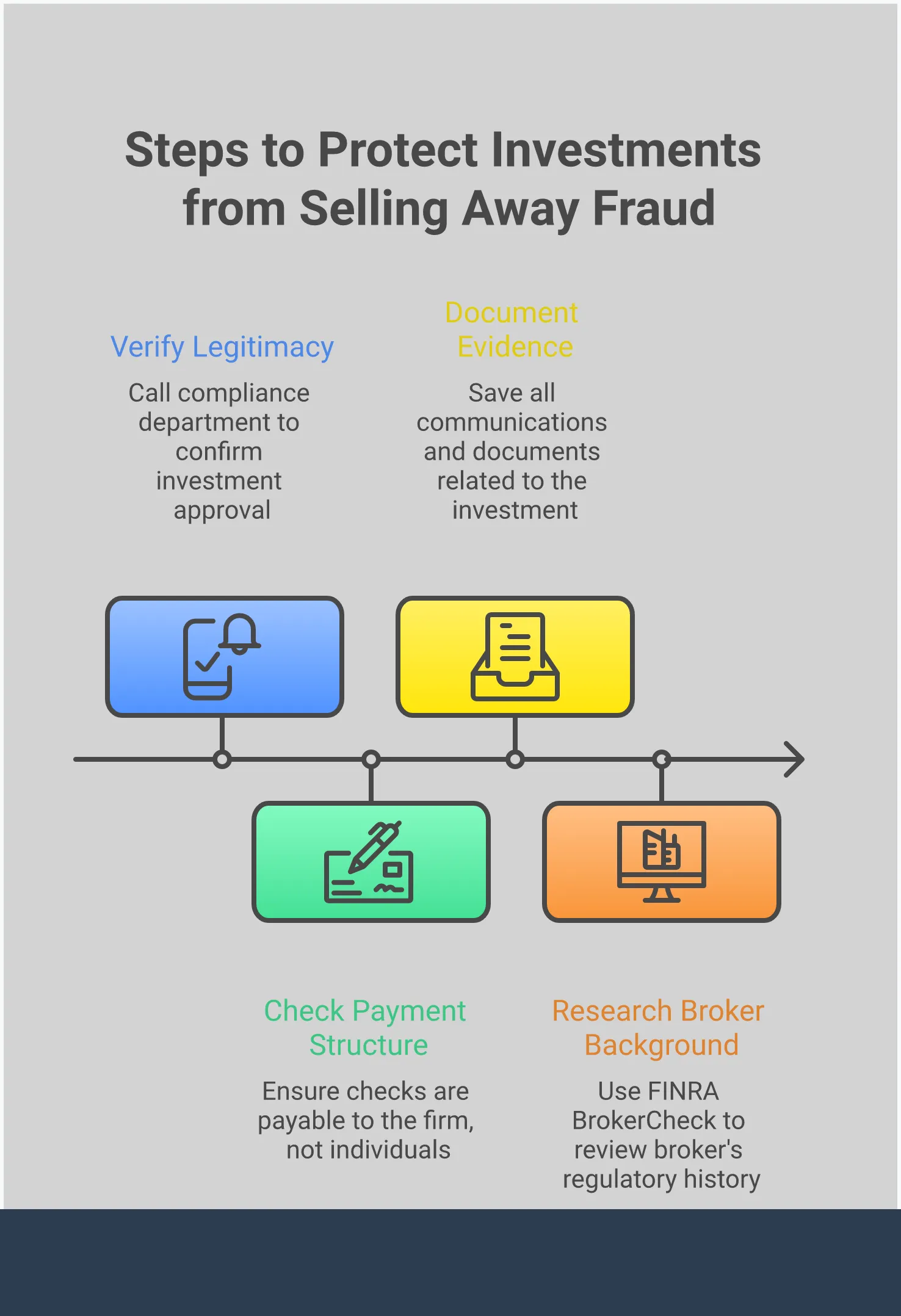
Realizing that your broker might be acting improperly can be unsettling, but taking clear, deliberate steps can make all the difference. If your gut tells you something is wrong, it’s time to listen. Protecting your investments starts with documenting your concerns and gathering the evidence you need to build a strong case. The following steps will help you organize your thoughts and materials, putting you in a better position to take action.
If you have a feeling that your broker is involved in misconduct like “selling away,” it’s crucial to act promptly. Trust your instincts. The first thing you should do is start documenting everything. FINRA guidelines require brokers to disclose all outside business activities to their firms, especially private securities transactions. If your broker is pushing an investment that seems off-the-books, that’s a major red flag. Write down your specific concerns, noting dates, conversations, and transactions. This initial record-keeping is a critical first step in protecting your financial future and exploring your legal options for broker fraud and negligence.
After you’ve documented your initial concerns, the next step is to systematically gather all related paperwork and digital records. Collect every email, text message, and piece of written correspondence you’ve exchanged with your broker. You should also pull together all of your account statements and transaction records, as these can provide clear evidence of unauthorized or unsuitable activities. Any proof that a deal was made outside the firm’s official channels is incredibly important. Organizing this information will create a clear timeline and a solid foundation if you decide to pursue a securities arbitration claim to recover your losses.
What’s the difference between a regular investment and one that’s “sold away”? Think of it like this: your brokerage firm has an official menu of investment products that they have reviewed and approved for their brokers to offer. A regular investment is something from that menu. “Selling away” happens when your broker convinces you to buy something that is not on the menu. This side deal completely bypasses the firm’s safety checks, leaving your money exposed to unvetted and often high-risk ventures.
If my broker was fired, is the brokerage firm still responsible for my losses? Yes, the firm can still be held responsible. Brokerage firms have a legal duty to supervise their employees to prevent misconduct like selling away. A broker being fired for misconduct doesn’t erase the firm’s failure to supervise them while they were employed. Your claim would likely focus on the firm’s supervisory failures that allowed the harmful activity to happen in the first place.
My broker recommended a private deal. How can I check if it’s legitimate? The most direct way is to call the compliance department of the brokerage firm itself. Use the phone number on your official account statement, not a number the broker gives you. Ask them directly if the investment you were offered is an approved product of the firm. If they have no record of it, that is a major red flag that you should not ignore.
I think I might be a victim of this. What is the very first thing I should do? Before you do anything else, start gathering all your documents. Collect every account statement, email, text message, and any notes you have from conversations related to the investment. Having this information organized is the best first step. Avoid confronting the broker directly and instead, consider speaking with a securities attorney who can review your documents and help you understand your specific legal options.
How long do I have to file a claim for investment losses? There are strict time limits for filing a securities arbitration claim, and they can be complex. These deadlines, known as statutes of limitation, vary depending on the specifics of your situation. Because of these time constraints, it is important to act promptly once you suspect something is wrong. Consulting with a legal professional can help you determine the exact window you have to pursue a claim for your losses.